
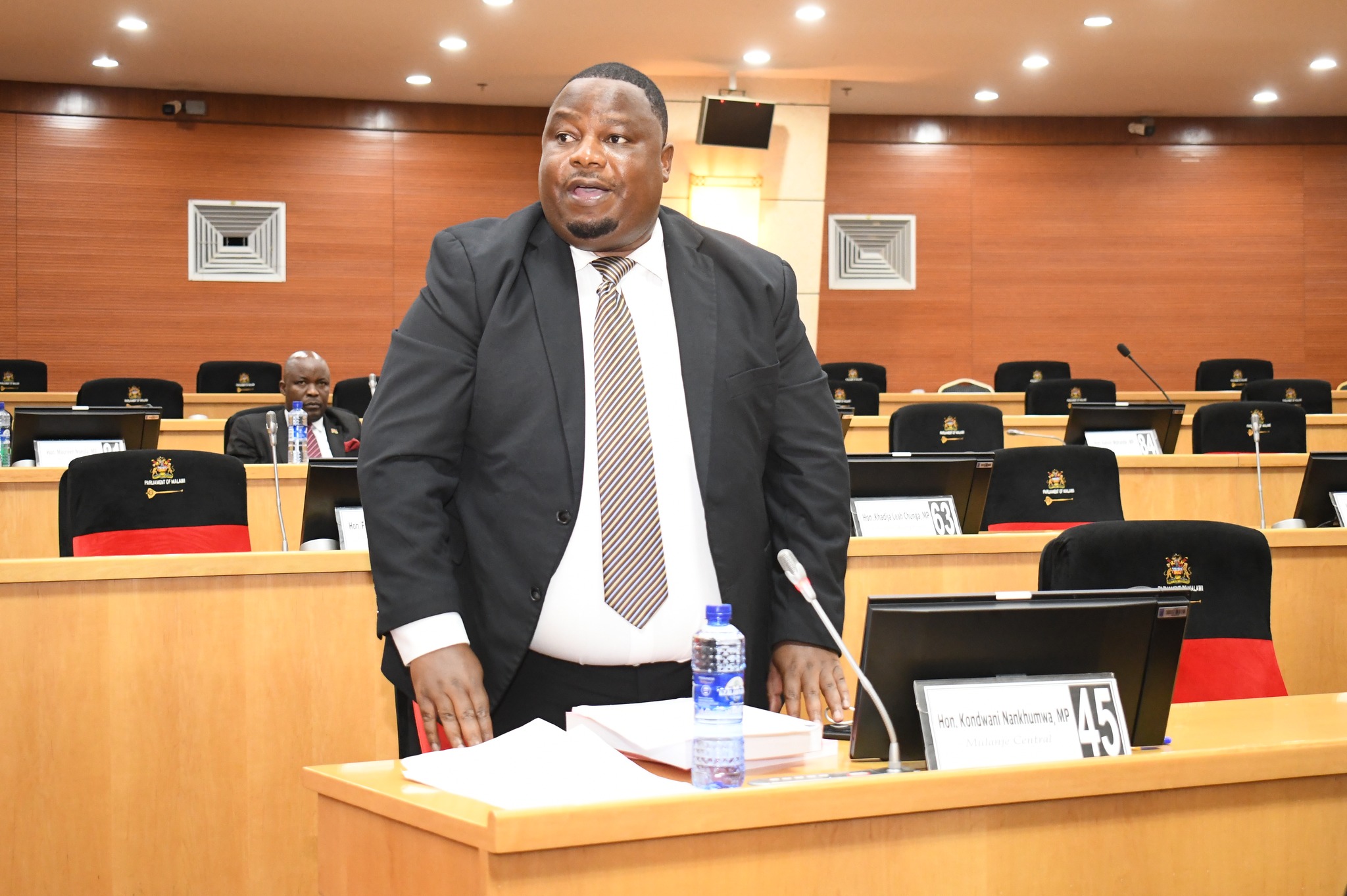
Mr. First Deputy Speaker, Sir,
I thank you for giving people of Mulanje Central the opportunity to respond to the 2026/27 National Budget presented by the Honourable Minister of Finance.
Let me begin by acknowledging the difficult economic environment under which this budget has been prepared. Malawi continues to face persistent inflation, serious shortages of foreign exchange, rising public debt, and slow economic growth.
Under such circumstances, Malawians naturally expect a budget that restores confidence in the economy, stimulates production, stabilizes prices, and provides a credible path toward sustainable growth.
Mr. First Deputy Speaker, Sir,
I wish to acknowledge the efforts Government has made in attempting to stabilize the economy during these challenging times. The implementation of expenditure control measures and attempts to strengthen domestic revenue mobilization are steps in the right direction.
Government also deserves recognition for interventions aimed at stabilizing food supply and supporting farmers during the lean period when many households face economic stress.
However, Mr. First Deputy Speaker, Sir, while these efforts are commendable, the central question remains whether the scale and design of the policies contained in this budget are sufficient to stabilize the economy and unlock meaningful growth.
It is on this basis that I wish to present several observations for the Honourable Minister’s consideration.
- Fiscal Promises Versus Fiscal Reality
Mr. First Deputy Speaker, Sir,
- This budget promises stability, yet it expands the fiscal deficit.
- It promises growth, yet investment in productive sectors remains insufficient.
- It promises transformation, yet the structure of expenditure continues to be dominated by consumption rather than production.
In simple terms, we are still spending more on running Government than on building the economy.
- Economic Growth Projections
Mr. First Deputy Speaker, Sir,
While every Malawian desires strong economic growth, the projected growth rate of 3.8 percent remains fragile under the current conditions.
Our economy is operating under serious foreign exchange shortages, high interest rates, and limited industrial investment. In the past five years, average growth has been around 1.2 percent. To suddenly expect the economy to jump to nearly 4 percent growth requires much deeper structural reforms than those reflected in this budget.
Growth cannot simply be declared in a budget speech; it must be built through deliberate investments in productive sectors.
- The Fiscal Deficit Challenge
Mr. First Deputy Speaker, Sir,
The second major concern is the fiscal position of Government.
The fiscal deficit continues to widen. In the 2024/25 financial year, the deficit reached K2.15 trillion. In 2025/26 it rose further to K2.9 trillion. For the 2026/27 financial year, the deficit is projected at K2.85 trillion.
Experience has shown that the actual deficit often exceeds what is approved in the budget. At this rate, the deficit could easily exceed K3 trillion.
A nation cannot borrow its way into prosperity. Every trillion Kwacha added to the deficit today becomes a burden carried by future generations of Malawians.
- The Debt Burden
Mr. First Deputy Speaker, Sir,
Perhaps the most alarming figure in this entire budget is the amount allocated to servicing public debt.
Interest payments alone are projected to reach approximately K2.79 trillion in the 2026/27 financial year.
Mr. First Deputy Speaker, Sir,
This means K2.79 trillion of taxpayers’ money will not build roads. It will not build irrigation schemes. It will not buy agricultural machinery. It will not create jobs.
It will simply go toward paying interest on past borrowing.
When a nation begins to spend more on servicing debt than on building its future, that nation must seriously reconsider its fiscal direction.
- Taxation and Cost of Living
Mr. First Deputy Speaker, Sir,
This level of debt burden inevitably leads to higher taxation of citizens and businesses.
Earlier adjustments to PAYEE, VAT, and the introduction of the electronic transactions levy had already increased the tax burden on Malawians.
However, this budget proposes additional taxes, including import surcharges on products such as fruits, kitchenware, aluminium pots, maize seed, diapers, and even toothpicks.
Such measures may increase the cost of living, particularly if local industries cannot immediately replace the imported products.
High import surcharges can also encourage smuggling and may create complications within regional trade arrangements under SADC and COMESA.
- Unrealistic Budget Commitments
Mr. First Deputy Speaker, Sir,
In the 2025/26 financial year, Government spent K8.43 trillion. Out of this amount, only K507 billion was allocated to locally funded development projects and K28.5 billion to the Constituency Development Fund (CDF), representing just 6.4 percent of total expenditure.
Even then, Government only managed to fund about 75 percent of the revised allocations.
Malawians are therefore asking a very simple question: if Government struggled to fully fund K46 billion for CDF last year, how will it realistically fund the proposed K865 billion within the expanded K1.15 trillion CDF framework?
Creating budgets that cannot be funded risks creating arrears, disrupting projects, and pushing councils into unsustainable contractual commitments.
- Government Expenditure Priorities
Mr. First Deputy Speaker, Sir,
Another area of concern is the continued growth in Government operational expenditure. In 2025/26, Government spent an inflated K709 billion on office operations during the election year. One would have expected these expenditures to be reduced or sanitized in the new financial year. Instead, they have increased further to K821 billion.
When operational costs rise faster than development spending, the result is predictable: productive sectors remain underfunded.
- Investment in Productive Sectors
Mr. First Deputy Speaker, Sir,
The future of Malawi’s economy lies in productive investment.
Agriculture, tourism, mining, and manufacturing have the potential to generate employment, foreign exchange, and long-term economic growth. However, allocations toward irrigation, mechanization, agricultural research, storage infrastructure, and agro-processing remain too low.
Without strong investment in these areas, the economy will struggle to grow sustainably.
- Mining: A Missed Opportunity
Mr. First Deputy Speaker, Sir,
The mining sector holds enormous potential to transform Malawi’s economic fortunes. For example, the Kasiya deposit is the second-largest rutile and graphite deposit in the world. It has the potential to generate approximately 645 million dollars annually for more than 50 years.
Yet mining revenues remain small relative to the sector’s potential, and there appears to be insufficient urgency in developing pipeline projects.
Malawi must move faster to unlock this opportunity.
- A Better Fiscal Framework
Mr. First Deputy Speaker, Sir,
Allow me to suggest an alternative fiscal approach.
Government could allocate K68.7 billion to the CDF, representing K300 million per constituency. Operational spending on generic goods and services could be limited to around K650 billion under a clear austerity framework.
At the same time, an additional K100 billion could be directed toward productive investments, with another K100 billion dedicated to completing ongoing development projects.
If the Malawi Revenue Authority addresses administrative and political challenges within tax administration, it is realistic to mobilize an additional K200 billion in revenue.
Such an approach could reduce the fiscal deficit to around K1.89 trillion, which is closer to the SADC recommended threshold of about 6 percent of GDP.
- A New Fiscal Direction for Malawi
Mr. First Deputy Speaker, Sir,
The People’s Development Party believes Malawi needs a new fiscal direction anchored on three key principles:
- Fiscal discipline
- Productive investment
- Private sector empowerment
Malawi does not suffer from a shortage of potential. We have fertile land, hardworking citizens, abundant natural resources, and enormous opportunities in tourism, mining, and agriculture.
What we suffer from is a shortage of bold economic decisions.
The time has come for Malawi to move from merely managing poverty to building prosperity.
I THANK YOU RIGHT HONOURABLE SPEAKER, SIR





Leave a Reply