

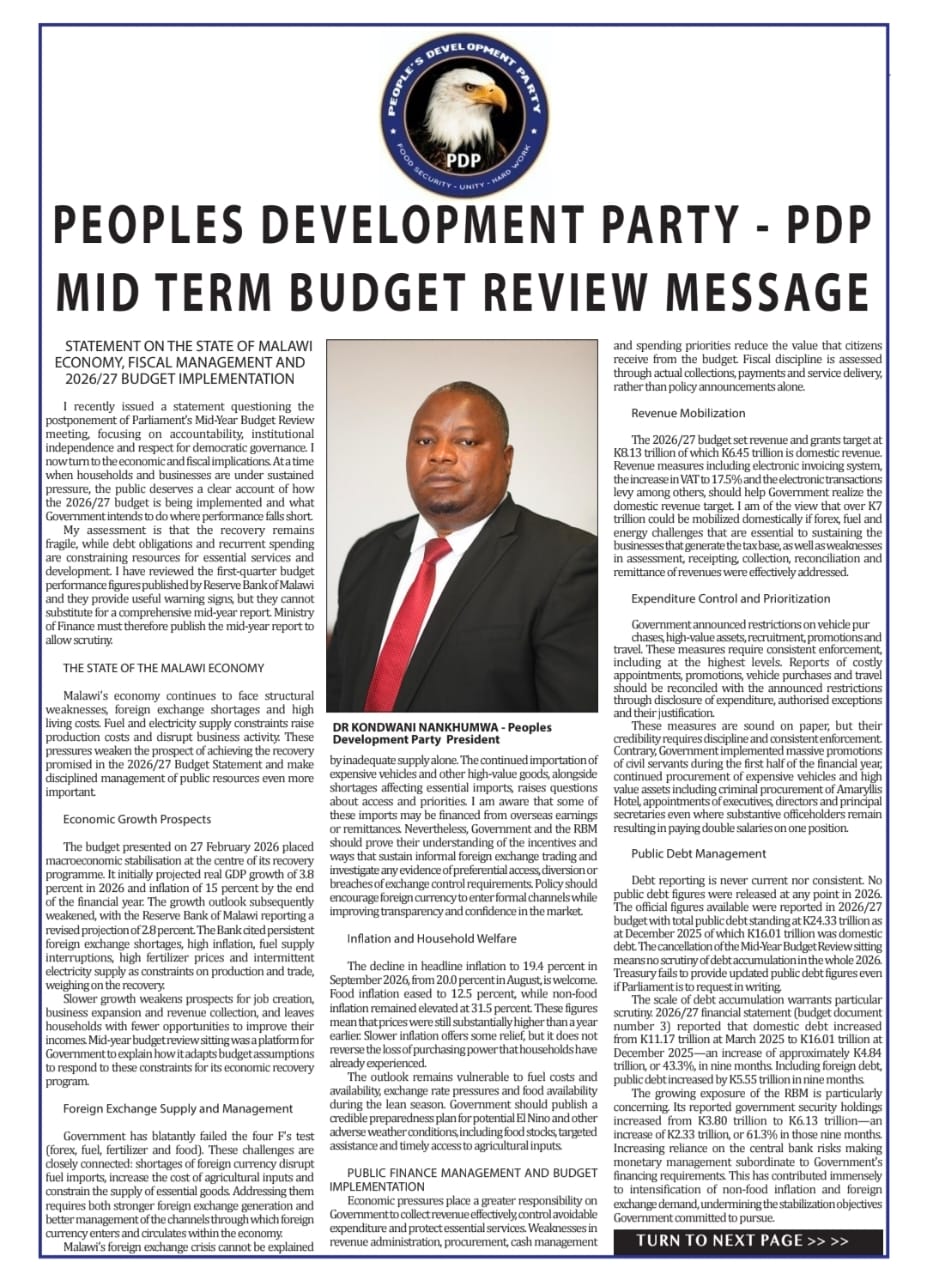
President Professor Arthur Peter Mutharika’s reported decision to postpone the gazetted sitting of Parliament scheduled for November 9 to December 11, 2026, has triggered constitutional questions, with People’s Development Party (PDP) leader Kondwani Nankhumwa demanding an immediate reversal of the decision.
At the centre of the controversy is whether the President consulted the Speaker of the National Assembly before the decision was made, as required under the constitutional framework governing the scheduling of parliamentary meetings.
In a statement dated October 30, 2026, Nankhumwa, who is also Member of Parliament for Mulanje Central, argued that the postponement raises serious concerns about parliamentary independence, the separation of powers and the limits of presidential authority.
He questioned whether the decision was made in accordance with Section 59(1) of the Constitution, which provides for the scheduling of National Assembly meetings through arrangements involving the Speaker and the President, while subsequent sittings are determined by the National Assembly.
“The Constitution does not confer upon the President an unrestricted or unilateral power to direct the Speaker to postpone or cancel duly scheduled parliamentary meetings or sittings,” Nankhumwa stated.
The critical question, however, is whether the constitutionally required consultation took place before the postponement was effected. Neither the fact of consultation nor its absence should be assumed without confirmation from the relevant offices.
Nankhumwa also questioned the reported compliance of the Speaker with the presidential directive, arguing that the Speaker has a responsibility to protect the independence and constitutional authority of Parliament rather than allow the institution to be subjected to executive direction.
He called on the Speaker to disclose the legal basis for the postponement and reconsider the decision, insisting that parliamentary business must be conducted in accordance with established constitutional and procedural requirements.
The PDP leader further raised concerns about the reported failure to convene the Parliamentary Business Committee to deliberate on the proposed postponement. He argued that any alteration to a gazetted parliamentary sitting should be supported by a lawful basis and appropriate institutional consultation.
The controversy carries significant implications for public financial accountability because the postponed sitting was intended to facilitate the Mid-Year Budget Review, a process through which Parliament examines government expenditure, fiscal performance, budgetary reallocations and the implementation of approved appropriations.
According to Nankhumwa, delaying the review risks postponing parliamentary scrutiny of public spending, government borrowing, statutory allocations and the implementation of development programmes at a time when the country is facing serious economic challenges.
He argued that Parliament’s oversight role becomes even more important during periods of economic hardship, when citizens expect elected representatives to question government decisions and demand explanations about the use of public resources.
The statement also links the postponement to the country’s prevailing fuel crisis and the President’s reported absence from Malawi for more than three weeks. Nankhumwa questioned the Government’s responsiveness to the hardships facing citizens and called for an explanation of the President’s absence and the measures being taken to address the crisis.
In a further development, the opposition leader raised questions about the authenticity and formal validity of the correspondence reportedly directing the postponement. Citing Section 90 of the Constitution, he called for the original correspondence to be made available for verification and for the President’s authorisation of the decision to be confirmed through an official channel.
These concerns remain allegations and questions raised by Nankhumwa; their resolution would require verification of the correspondence and clarification from the relevant authorities.
Nankhumwa’s position is that the decision should be reversed immediately and that the parliamentary sitting scheduled for November 9 to December 11 should be restored. He also called for the appropriate involvement of the Parliamentary Business Committee and the timely resumption of parliamentary scrutiny of public finances.
The unfolding dispute now places the spotlight on the offices of the President and the Speaker of the National Assembly.
Did the two offices consult before the decision was taken? What constitutional and procedural basis was relied upon to postpone the gazetted sitting? Was the Parliamentary Business Committee consulted, and what formal process was followed to communicate the change?
These are questions that require clear answers from the relevant authorities.
Beyond the political disagreement, the matter raises a fundamental issue about the balance of power between the Executive and the Legislature. Parliament’s ability to scrutinise government decisions and public expenditure is central to democratic accountability, particularly when the country is grappling with economic difficulties.
As Nankhumwa argues, the Constitution must be respected by all public office holders. Whether the postponement complied with its requirements is a matter that demands transparent clarification rather than political assumption.





Leave a Reply