
I recently issued a statement questioning the postponement of Parliament’s Mid-Year Budget Review meeting, focusing on accountability, institutional independence and respect for democratic governance. I now turn to the economic and fiscal implications. At a time when households and businesses are under sustained pressure, the public deserves a clear account of how the 2026/27 budget is being implemented and what Government intends to do where performance falls short.
My assessment is that the recovery remains fragile, while debt obligations and recurrent spending are constraining resources for essential services and development. I have reviewed the first-quarter budget performance figures published by Reserve Bank of Malawi and they provide useful warning signs, but they cannot substitute for a comprehensive mid-year report. Ministry of Finance must therefore publish the mid-year report to allow scrutiny.
THE STATE OF THE MALAWI ECONOMY
Malawi’s economy continues to face structural weaknesses, foreign exchange shortages and high living costs. Fuel and electricity supply constraints raise production costs and disrupt business activity. These pressures weaken the prospect of achieving the recovery promised in the 2026/27 Budget Statement and make disciplined management of public resources even more important.
Economic Growth Prospects
The budget presented on 27 February 2026 placed macroeconomic stabilisation at the centre of its recovery programme. It initially projected real GDP growth of 3.8 percent in 2026 and inflation of 15 percent by the end of the financial year. The growth outlook subsequently weakened, with the Reserve Bank of Malawi reporting a revised projection of 2.8 percent. The Bank cited persistent foreign exchange shortages, high inflation, fuel supply interruptions, high fertilizer prices and intermittent electricity supply as constraints on production and trade, weighing on the recovery.
Slower growth weakens prospects for job creation, business expansion and revenue collection, and leaves households with fewer opportunities to improve their incomes. Mid-year budget review sitting was a platform for Government to explain how it adapts budget assumptions to respond to these constraints for its economic recovery program.
Foreign Exchange Supply and Management
Government has blatantly failed the four F’s test (forex, fuel, fertilizer and food). These challenges are closely connected: shortages of foreign currency disrupt fuel imports, increase the cost of agricultural inputs and constrain the supply of essential goods. Addressing them requires both stronger foreign exchange generation and better management of the channels through which foreign currency enters and circulates within the economy.
Malawi’s foreign exchange crisis cannot be explained by inadequate supply alone. The continued importation of expensive vehicles and other high-value goods, alongside shortages affecting essential imports, raises questions about access and priorities. I am aware that some of these imports may be financed from overseas earnings or remittances. Nevertheless, Government and the RBM should prove their understanding of the incentives and ways that sustain informal foreign exchange trading and investigate any evidence of preferential access, diversion or breaches of exchange control requirements. Policy should encourage foreign currency to enter formal channels while improving transparency and confidence in the market.
Inflation and Household Welfare
The decline in headline inflation to 19.4 percent in September 2026, from 20.0 percent in August, is welcome. Food inflation eased to 12.5 percent, while non-food inflation remained elevated at 31.5 percent. These figures mean that prices were still substantially higher than a year earlier. Slower inflation offers some relief, but it does not reverse the loss of purchasing power that households have already experienced.
The outlook remains vulnerable to fuel costs and availability, exchange rate pressures and food availability during the lean season. Government should publish a credible preparedness plan for potential El Nino and other adverse weather conditions, including food stocks, targeted assistance and timely access to agricultural inputs.
PUBLIC FINANCE MANAGEMENT AND BUDGET IMPLEMENTATION
Economic pressures place a greater responsibility on Government to collect revenue effectively, control avoidable expenditure and protect essential services. Weaknesses in revenue administration, procurement, cash management and spending priorities reduce the value that citizens receive from the budget. Fiscal discipline is assessed through actual collections, payments and service delivery, rather than policy announcements alone.
Revenue Mobilization
The 2026/27 budget set revenue and grants target at K8.13 trillion of which K6.45 trillion is domestic revenue. Revenue measures including electronic invoicing system, the increase in VAT to 17.5% and the electronic transactions levy among others, should help Government realize the domestic revenue target. I am of the view that over K7 trillion could be mobilized domestically if forex, fuel and energy challenges that are essential to sustaining the businesses that generate the tax base, as well as weaknesses in assessment, receipting, collection, reconciliation and remittance of revenues were effectively addressed.
Expenditure Control and Prioritization
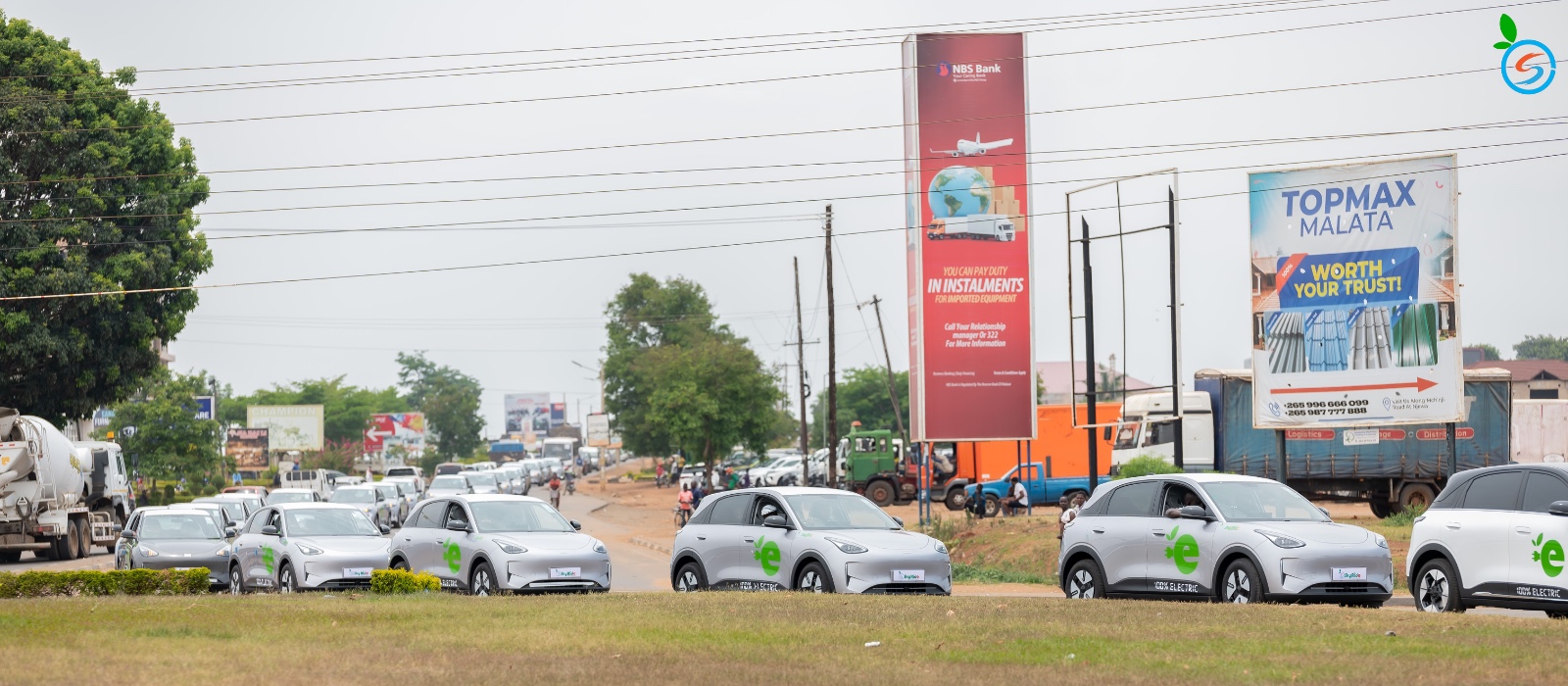
Government announced restrictions on vehicle purchases, high-value assets, recruitment, promotions and travel. These measures require consistent enforcement, including at the highest levels. Reports of costly appointments, promotions, vehicle purchases and travel should be reconciled with the announced restrictions through disclosure of expenditure, authorised exceptions and their justification.
These measures are sound on paper, but their credibility requires discipline and consistent enforcement. Contrary, Government implemented massive promotions of civil servants during the first half of the financial year, continued procurement of expensive vehicles and high value assets including criminal procurement of Amaryllis Hotel, appointments of executives, directors and principal secretaries even where substantive officeholders remain resulting in paying double salaries on one position.
Public Debt Management
Debt reporting is never current nor consistent. No public debt figures were released at any point in 2026. The official figures available were reported in 2026/27 budget with total public debt standing at K24.33 trillion as at December 2025 of which K16.01 trillion was domestic debt. The cancellation of the Mid-Year Budget Review sitting means no scrutiny of debt accumulation in the whole 2026. Treasury fails to provide updated public debt figures even if Parliament is to request in writing.
The scale of debt accumulation warrants particular scrutiny. 2026/27 financial statement (budget document number 3) reported that domestic debt increased from K11.17 trillion at March 2025 to K16.01 trillion at December 2025—an increase of approximately K4.84 trillion, or 43.3%, in nine months. Including foreign debt, public debt increased by K5.55 trillion in nine months.
The growing exposure of the RBM is particularly concerning. Its reported government security holdings increased from K3.80 trillion to K6.13 trillion—an increase of K2.33 trillion, or 61.3% in those nine months. Increasing reliance on the central bank risks making monetary management subordinate to Government’s financing requirements. This has contributed immensely to intensification of non-food inflation and foreign exchange demand, undermining the stabilization objectives Government committed to pursue.
REFLECTIONS ON 2026/27 BUDGET IMPLEMENTATION
The only budget execution data available pertain to first quarter (April-June 2026) published by the RBM. The opening quarter showed stronger domestic revenue collections and a narrower cash deficit, alongside weak grants, a heavy interest burden and limited spending on goods and services and development projects.
Revenue Performance
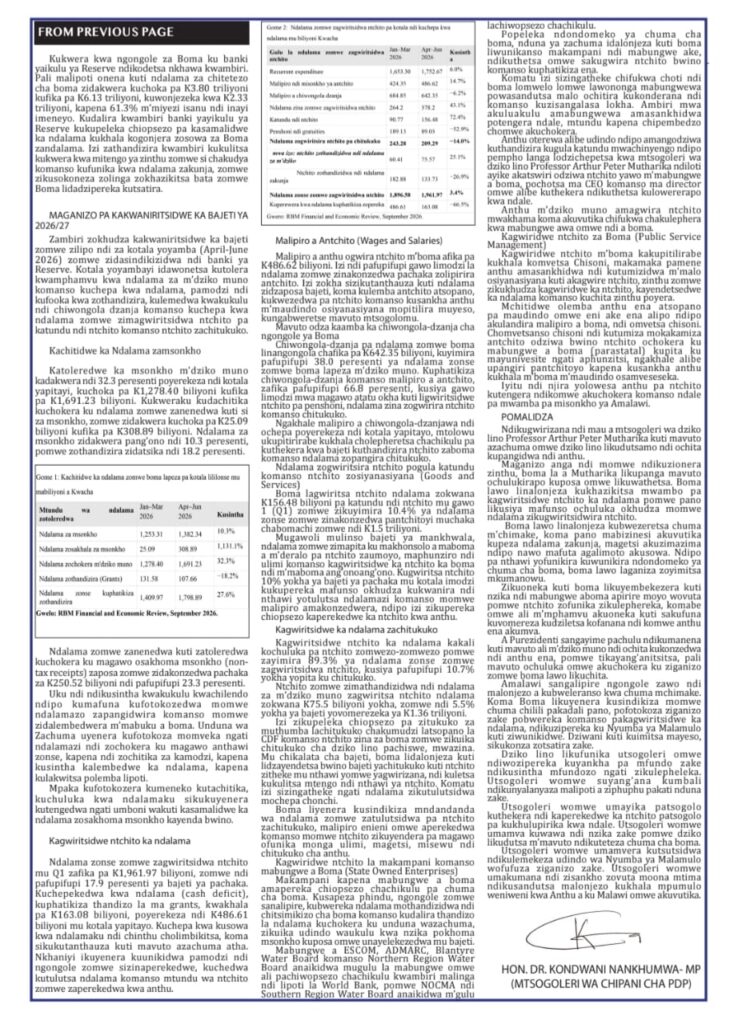
Domestic revenue increased by 32.3 percent over the preceding quarter, from K1,278.40 billion to K1,691.23 billion. Most of the increase came from reported non-tax receipts, which rose from K25.09 billion to K308.89 billion. Tax revenue grew by moderate 10.3 percent, while grants declined by 18.2 percent.
Table 1: Quarterly revenue performance in K’ billion
| Revenue category | Jan–Mar 2026 | Apr–Jun 2026 | Change |
| Tax revenue | 1,253.31 | 1,382.34 | 10.3% |
| Non-tax revenue | 25.09 | 308.89 | 1,131.1% |
| Domestic revenue | 1,278.40 | 1,691.23 | 32.3% |
| Grants | 131.58 | 107.66 | −18.2% |
| Total revenue and grants | 1,409.97 | 1,798.89 | 27.6% |
Source: RBM Financial and Economic Review, September 2026.
The reported non-tax receipts exceed the annual provision of K250.52 billion by approximately 23.3 percent. This is an unusually large collection and requires an explanation of its composition and accounting treatment. Treasury should clarify whether it reflects recurring receipts, a one-off transaction, a reclassification or a reporting error. Until that explanation is available, the increase must not be treated as evidence of an improvement in non-tax revenue mobilization.
Expenditure Performance
Total expenditure in Q1 amounted to K1,961.97 billion, approximately 17.9 percent of the annual budget. The resulting cash deficit, including grants, was K163.08 billion, compared with K486.61 billion in the preceding quarter. A smaller cash deficit is encouraging, but it does not establish that fiscal pressures have been resolved. It must be assessed alongside unpaid bills, delayed releases and the quality of services delivered.
Table 2: Quarterly expenditure and cash deficit in K’ billion
| Expenditure category | Jan–Mar 2026 | Apr–Jun 2026 | Change |
| Recurrent expenditure | 1,653.30 | 1,752.67 | 6.0% |
| Wages and salaries | 424.35 | 486.62 | 14.7% |
| Interest payments | 684.85 | 642.35 | −6.2% |
| Other expenditures | 264.2 | 378.2 | 43.1% |
| Goods and services | 90.77 | 156.48 | 72.4% |
| Pensions and gratuities | 189.13 | 89.03 | −52.9% |
| Development expenditure | 243.28 | 209.29 | −14.0% |
| of which: domestically financed projects | 60.41 | 75.57 | 25.1% |
| Foreign-financed projects | 182.88 | 133.73 | −26.9% |
| Total expenditure | 1,896.58 | 1,961.97 | 3.4% |
| Cash deficit including grants | 486.61 | 163.08 | −66.5% |
Source: RBM Financial and Economic Review, September 2026.
Wages and Salaries
Wages and salaries amounted to K486.62 billion. This is approximately one-quarter of the annual wage provision. It does not by itself establish an impending overrun, but recruitment, promotions and overlapping appointments could increase pressure later in the year.
The Public Debt Interest Burden
Interest payments of K642.35 billion absorbed approximately 38.0 percent of domestic revenue. Together, interest and wages consumed about 66.8 percent, leaving only one-third before pensions, other operating costs and development requirements. Although interest payments were lower than in the preceding quarter, the burden remains a major constraint on the budget’s ability to support services and productive investment.
Expenditure on Goods and Services
Government spent K156.48 billion on goods and services in Q1 representing 10.4% of the annual provision of K1.5 trillion. This budget line includes drug budget, recurrent transfers to local councils’ health, education and agriculture sectors and general central and local government operations. Spending 10% of annual budget in a quarter raises questions about the adequacy and timing of funding releases and payment processing and threatens service delivery.
Development Expenditure
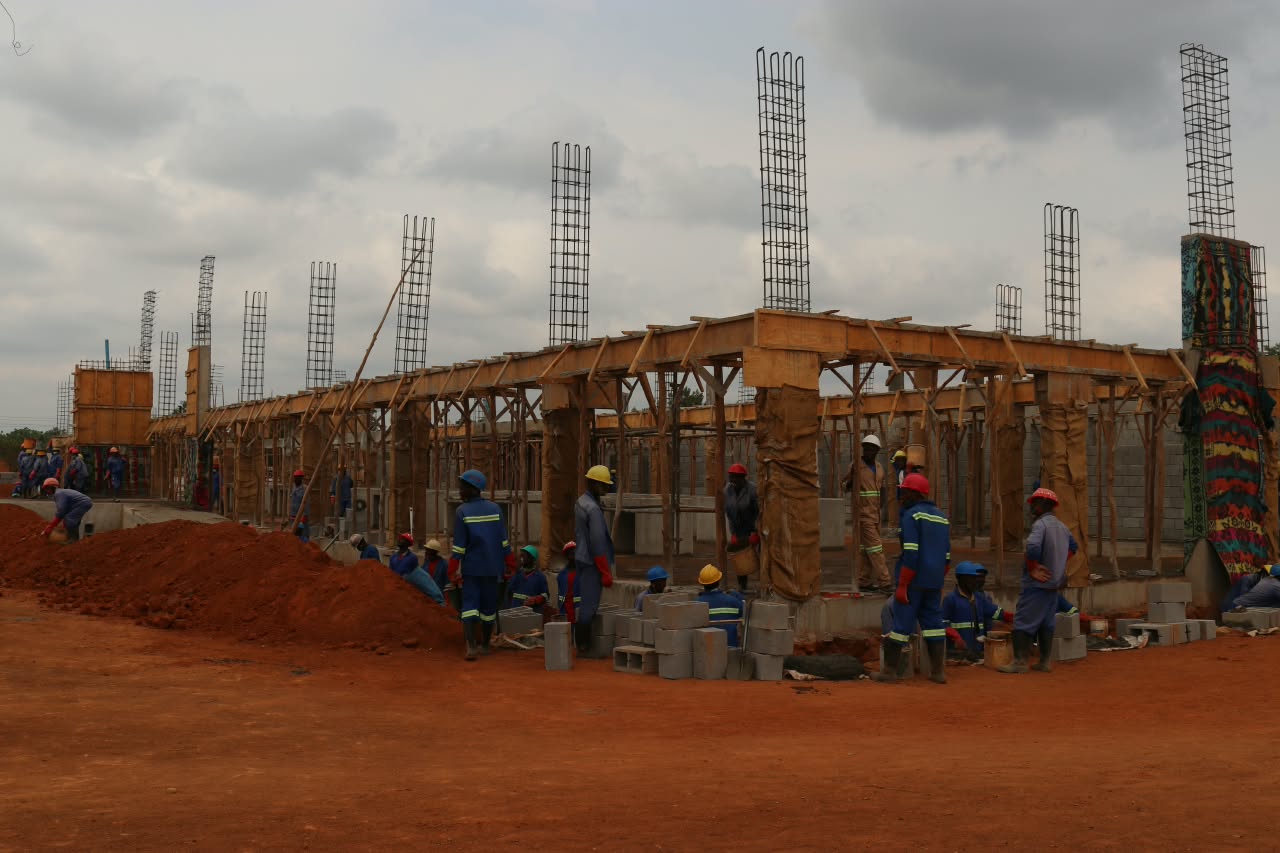
Spending remains predominantly recurrent. Recurrent expenditure represented 89.3% of total expenditure, leaving approximately 10.7% for development. Domestic financed projects spent only K75.5 billion which is just 5.5% of approved budget of K1.36 trillion. This threatens implementation of the inflated CDF and central government projects putting national development in jeopardy, to say the least. Budget statement pledged that Government would manage development budget to see projects completed within agreed periods, with tightly restricted cost and time extensions. This is not achievable under constrained funding.
Government should publish project fund releases, actual payments and physical progress across important sectors of agriculture, energy, road and social sectors.
State Owned Enterprises Management and Performance
State-owned enterprises constitute a major fiscal risk to Government. Persistent losses, payment arrears, government-guaranteed borrowing and dependence on Treasury bailouts and capital injections expose taxpayers to obligations beyond those immediately visible in the budget. ESCOM, ADMARC, Blantyre Water Board and Northern Region Water Board were placed in the highest-risk category by World Bank report, while NOCMA and Southern Region Water Board were classified as high risk.
The Minister of Finance pledged in his budget statement that Government would review all SOEs and close non-performing ones and merge some. This cannot be implemented because it is the same Government that has crippled the enterprises by turning them into grounds for patronage and appeasements. Majority of the executives and directors are appointed on political, tribal or religious basis. Such people lack sense of responsibility and are good only at facilitating corrupt procurements. My humble appeal to president Mutharika is to professionalize the SOEs by replacing incompetent CEOs and directors and end political interference. Hard working Malawians are being let down by poor service delivery from these agriculture, water and energy sector SOEs.
Public Service Management
Public service management remains an area of concern, particularly where appointments and deployment decisions weaken service delivery, expenditure control and accountability. Tendency to recruit replacements for positions whose substantive holders remain on the payroll whereby duplicating salary obligations is sad. Equally concerning are involuntary secondments of experienced parastatal employees to universities as lecturers, despite limited or no teaching experience, or to advisory positions in the mainstream civil service with unclear responsibilities. Such arrangements are mechanisms for creating a vacancy for tribal and political patrons at the expense of tax payers’ money.
CONCLUSION
I wish to agree with President Mutharika that Malawi’s economic difficulties are man-made. In my considered view, his Government is creating more problems than it solves. It promises fiscal discipline while leaving serious questions about spending priorities unanswered. It promises recovery while businesses struggle for foreign exchange, electricity and reliable fuel supplies. And when the time comes to account for budget implementation, the parliamentary meeting intended for that scrutiny is postponed. Apparently, Government expects citizens and public institutions to endure austerity and hardship while essential services remain constrained, yet those in power appear unwilling to accept similar restraint or scrutiny.
The President cannot credibly lament man-made problems while overlooking those arising from his own administration’s decisions. Malawians cannot pay their bills with promises of recovery. Government must publish the mid-year fiscal position, explain its borrowing and expenditure decisions, and submit them to parliamentary scrutiny. Postponing the examination does not improve the results. The country needs leadership willing to account for its choices and change course where those choices are failing. Leadership that does not look away and ignore reports of corrupt practices among members of his cabinet. Leadership that puts competence and public service delivery ahead of political loyalty. Leadership that shares the sacrifices it asks of citizens and safeguards public resources. Leadership that listens to criticism and respects Parliament’s duty to scrutinize its decisions. Leadership that confronts difficult choices honestly and turns promises into practical relief for struggling Malawians.




Leave a Reply